
Wheel Alignment vs Wheel Balancing: What's the Difference?
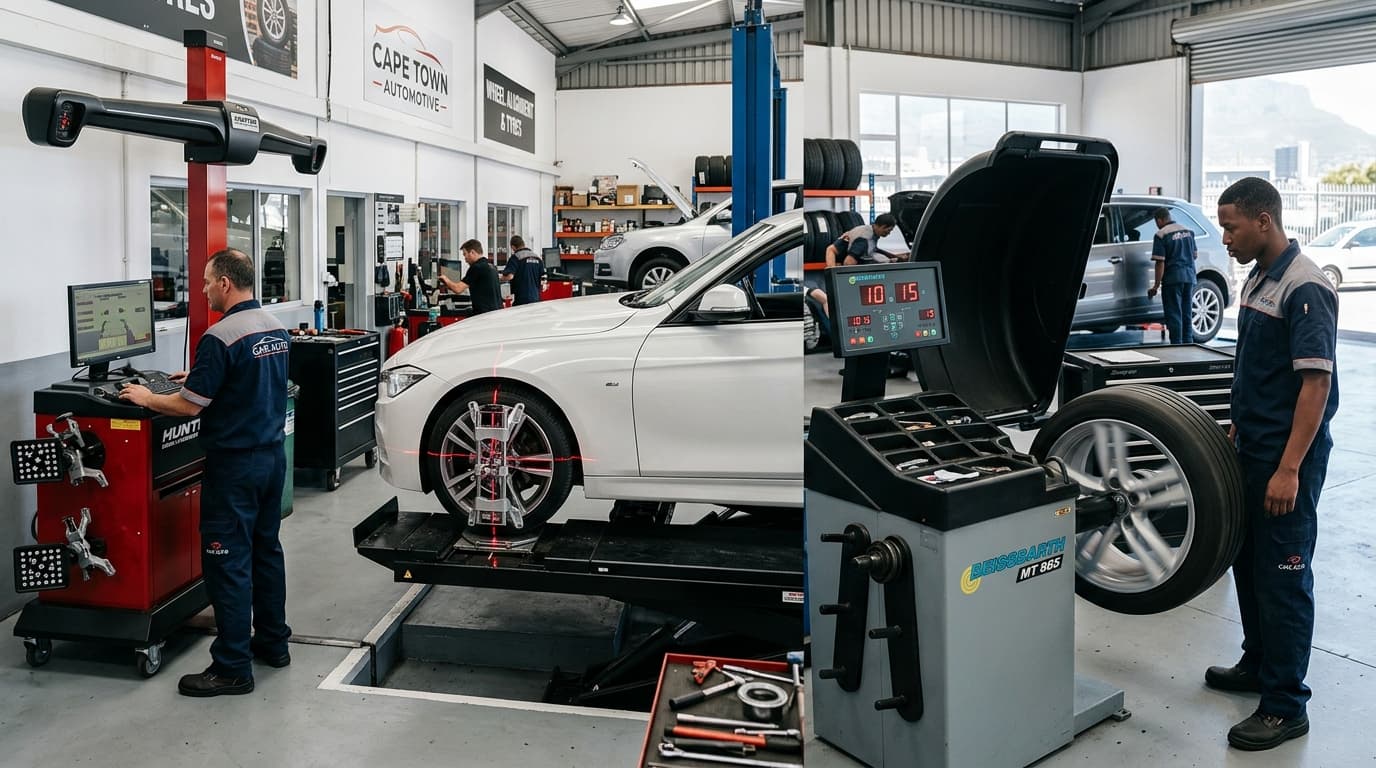
If you've ever taken your car in for a tyre change or noticed your steering pulling to one side, you've probably heard the terms "wheel alignment" and "wheel balancing" thrown around. Many drivers use them interchangeably, but wheel alignment vs balancing refers to two very different services — and understanding the difference can save you money, extend your tyre life, and keep you safer on Cape Town's roads.
At Speedline Mags in Parow, we see the consequences of neglected alignment and balancing every week: unevenly worn tyres, vibrating steering wheels, and wheels that have suffered unnecessary damage. In this guide, we'll break down exactly what each service involves, when you need them, what they cost, and how they work together to keep your vehicle running smoothly.
What Is Wheel Alignment?
Wheel alignment — sometimes called tracking — is the process of adjusting the angles of your wheels so they sit perfectly according to the manufacturer's specifications. It has nothing to do with the wheels themselves; it's about the suspension system that connects your wheels to the vehicle.
There are three main angles that technicians adjust during an alignment:
Camber
Camber refers to the inward or outward tilt of the wheel when viewed from the front of the vehicle. If the top of the wheel leans outward, that's positive camber. If it leans inward, that's negative camber. Incorrect camber causes uneven tyre wear on one side and can make your car pull in one direction.
Toe
Toe describes whether the fronts of your tyres point inward (toe-in) or outward (toe-out) when viewed from above. Think of it like looking down at your feet — your toes can point inward or outward. Incorrect toe alignment is one of the most common causes of rapid, uneven tyre wear.
Caster
Caster is the angle of your steering axis when viewed from the side. It affects steering stability and cornering. While caster doesn't usually cause tyre wear, incorrect caster makes the car feel unstable at speed and can cause the steering to feel heavy or wander.
When Do You Need a Wheel Alignment?
You should have your alignment checked at least once a year, but several situations call for an immediate check. If your car pulls to the left or right on a straight, flat road, that's a classic sign. Uneven tyre wear — where one edge wears faster than the other — is another red flag. A crooked steering wheel when driving straight is also a giveaway.
Cape Town drivers face a particular alignment challenge: potholes. The roads around Bellville, the N1, and many of the Northern Suburbs routes are notorious for potholes that can knock your alignment out in a single hit. If you've recently hit a significant pothole or driven over a kerb, it's worth getting your alignment checked. For more on pothole-related damage, see our guide on how potholes damage your wheels.
You should also get an alignment after fitting new tyres, replacing suspension components, or if you've been in any kind of collision — even a minor one.
What Is Wheel Balancing?
Wheel balancing is a completely different process. It ensures that the weight of the wheel and tyre combination is distributed evenly around the axle. Even brand-new tyres aren't perfectly uniform — there are always slight variations in weight distribution caused by the valve stem, manufacturing tolerances, and the tyre's construction.
During balancing, a technician mounts the wheel on a specialised balancing machine that spins it at high speed. The machine detects where the heavy spots are, and the technician attaches small counterweights — either clip-on or adhesive — to the rim to correct the imbalance.
There are two types of imbalance that the machine detects:
Static imbalance causes the wheel to bounce or hop up and down. This happens when there's a heavy spot on one point of the wheel's circumference.
Dynamic imbalance causes the wheel to wobble side to side. This occurs when the weight isn't evenly distributed across the width of the wheel.
Modern balancing machines detect both types simultaneously and indicate exactly where weights need to be placed for a perfectly balanced wheel.
When Do You Need Wheel Balancing?
The most obvious sign that your wheels need balancing is vibration — particularly through the steering wheel at speeds between 80 and 120 km/h. If the vibration is felt more through the seat than the steering wheel, it's often the rear wheels that are out of balance.
You should have your wheels balanced every time you fit new tyres, rotate your tyres, or repair a puncture. It's also good practice to rebalance every 10,000 to 12,000 kilometres, as weights can shift or fall off over time, and tyres wear unevenly as they age.
If you're experiencing steering vibration, check out our article on signs your wheels need professional repair for a deeper look at diagnosing wheel issues.
Wheel Alignment vs Balancing: Key Differences
Now that we've covered both services individually, let's put the differences side by side so you can clearly see how wheel alignment vs balancing compare.
What's being adjusted: Alignment adjusts the angles of the suspension and how the wheels sit relative to the car and the road. Balancing adjusts the weight distribution around the wheel and tyre assembly.
The problem it solves: Alignment corrects pulling, uneven tyre wear, and poor handling. Balancing corrects vibration and uneven rotational forces.
Equipment used: Alignment uses laser or camera-based alignment racks that measure suspension geometry. Balancing uses a spinning machine that detects weight imbalances.
How often it's needed: Alignment should be checked annually or after impacts. Balancing should be done with every tyre change and every 10,000–12,000 km.
What gets physically changed: During alignment, suspension bolts and components are adjusted. During balancing, small weights are added to the rim.
Typical cost in South Africa: A four-wheel alignment in Cape Town typically runs between R350 and R600. Wheel balancing usually costs R50 to R100 per wheel, or R200 to R400 for all four.
Why Both Services Matter for Your Wheels
Here's something many drivers don't realise: alignment and balancing problems don't just affect your tyres and comfort — they can damage your alloy wheels over time.
A car that's badly out of alignment puts uneven stress on the wheel, particularly during cornering and braking. Over months of driving, this can cause fatigue in the alloy, making the wheel more susceptible to cracking or buckling when it hits a pothole. We've repaired plenty of cracked and buckled wheels at Speedline Mags where poor alignment was a contributing factor.
Similarly, a severely unbalanced wheel creates repetitive impact forces on the rim with every rotation. At 100 km/h, a typical wheel rotates around 800 times per minute. If there's an imbalance, that's 800 impacts per minute hammering the same spot on the wheel, the hub bearing, and the suspension. Over time, this accelerates wear on all these components.
The bottom line: keeping your alignment and balance in check isn't just about comfort or tyre life — it's about protecting your wheels and suspension from premature damage.
Common Myths About Alignment and Balancing
"New tyres don't need balancing"
This is false. New tyres always need balancing. No tyre comes off the production line perfectly balanced, and the combination of a specific tyre on a specific rim creates a unique weight distribution that needs to be measured and corrected.
"Alignment only matters for the front wheels"
Modern cars benefit from four-wheel alignment. Even if only the front wheels are steerable, the rear wheels' angles affect handling, tyre wear, and stability. Many vehicles — particularly SUVs and performance cars common in South Africa like the BMW 3 Series and VW Golf — have adjustable rear suspension that can go out of alignment.
"I can feel when my alignment is off"
Not always. Mild alignment issues can go unnoticed from the driver's seat while silently chewing through your tyres. You might not feel a pull if both sides are equally out of spec, but your tyres will still wear unevenly. The first sign might be when your tyre fitter shows you that your 30,000 km tyres have the tread of 60,000 km tyres — on one side only.
"Balancing weights falling off is normal"
While it can happen, it shouldn't happen frequently. If weights keep falling off, it may indicate a poorly cleaned rim surface, the wrong type of weight for your wheel, or a deeper issue with the rim itself. If you're running aftermarket or refurbished alloy wheels, ensure the technician uses adhesive weights rather than clip-on weights that may not fit the rim profile correctly.
How Alignment and Balancing Affect Different Vehicles
The impact of poor alignment or balancing varies depending on your vehicle. Here's what we commonly see at our Parow workshop:
Bakkies and SUVs
Vehicles like the Toyota Hilux and Ford Ranger are particularly sensitive to alignment issues because of their heavier weight and the loads they carry. A bakkie that's frequently loaded or used for towing will go out of alignment faster than a city car. The larger wheel and tyre combinations on these vehicles also mean that imbalances are felt more strongly. If you drive a Hilux, our Toyota wheel repair guide covers common wheel issues for these popular bakkies.
Performance and Luxury Cars
BMW, Mercedes-Benz, and Audi vehicles often have more complex multi-link rear suspension that offers more alignment adjustability — but also more that can go wrong. These cars are also typically fitted with lower-profile tyres that transmit vibrations more directly to the cabin, making imbalances more noticeable. Our BMW wheel repair guide and Mercedes repair guide have more details on caring for these vehicles' wheels.
City Cars
The VW Polo, one of South Africa's best-selling cars, is generally forgiving when it comes to minor alignment issues, but that doesn't mean they should be ignored. We regularly see Polos come in with completely bald inside edges on the front tyres — a classic sign of prolonged negative camber or toe misalignment. Replacing those tyres costs far more than the alignment that would have prevented the wear. For VW-specific guidance, see our VW Polo and Golf wheel repair guide.
The Cost of Neglecting Alignment and Balancing
Let's talk about the real-world financial impact of skipping these services.
A set of four quality tyres for a mid-range sedan in South Africa costs between R4,000 and R8,000. Proper alignment and balancing might cost R600 to R800 combined. If poor alignment causes your tyres to wear out at 25,000 km instead of 50,000 km, you're effectively doubling your tyre costs. That R600 alignment would have saved you R4,000 to R8,000 in premature tyre replacement.
Then there's fuel consumption. A car with poor alignment creates more rolling resistance, which means your engine works harder. Studies suggest that misaligned wheels can increase fuel consumption by up to 10%. For a Cape Town commuter driving 20,000 km per year, that could add up to R2,000 to R3,000 in extra fuel costs annually.
And finally, there's the wheel damage. As we mentioned, poor alignment and balancing accelerate wear on your alloy wheels. A professional wheel repair typically costs between R500 and R1,500 per wheel, and some types of damage — like severe cracking — may require complete replacement at R3,000 to R10,000 or more per wheel depending on the vehicle.
Tips for Cape Town Drivers
Cape Town's unique driving conditions make alignment and balancing even more important:
Watch for potholes on arterial routes. The N1, Voortrekker Road, and many routes through Bellville and Parow Industria are pothole-prone, especially after the winter rains. A single bad pothole hit can knock your alignment out instantly.
Check after long gravel road trips. If you've been exploring the West Coast or Winelands on dirt roads, book an alignment check when you're back. Sustained driving on uneven surfaces gradually shifts alignment angles.
Don't skip balancing when rotating tyres. Many tyre shops include balancing in their rotation service, but some don't. Always ask, and always insist on it.
Inspect your wheels regularly. When you wash your car or check your tyre pressure, take a moment to look at your tyre wear pattern. Uneven wear is the earliest visible sign of alignment or balancing problems. Our guide on the ultimate wheel care routine covers what to look for.
When to See a Wheel Specialist
While tyre shops handle routine alignment and balancing, some situations call for a wheel specialist. If you're experiencing persistent vibration after balancing, the issue may be a bent or buckled rim rather than a balance problem. A warped rim can't be fixed with weights — it needs professional wheel straightening.
Similarly, if your car keeps going out of alignment despite repeated adjustments, there may be worn or damaged suspension components — bushings, ball joints, or tie rod ends — that need replacing before an alignment will hold.
At Speedline Mags, we don't just repair cosmetic wheel damage. We assess the structural integrity of your wheels and can identify issues that a standard tyre shop might miss. If your wheels have been damaged by potholes, kerb strikes, or accidents, we can repair or refurbish them to factory specification before you have your alignment and balancing done.
Get Your Wheels Checked at Speedline Mags
Whether you need wheel repair, refurbishment, or just want expert advice on looking after your wheels, the team at Speedline Mags in Parow is here to help. We work with all major vehicle brands and specialise in alloy wheel repair, diamond cutting, and powder coating for drivers across Cape Town's Northern Suburbs and beyond.
If your steering is vibrating, your car is pulling, or your tyres are wearing unevenly, don't wait until it gets worse. Contact Speedline Mags today for a professional assessment and keep your wheels — and your wallet — in good shape.